How Food Additives Affect ADHD/Autism: What Parents Need to Know
Are food additives making your child’s ADHD or autism symptoms worse? Emerging research, and what I...
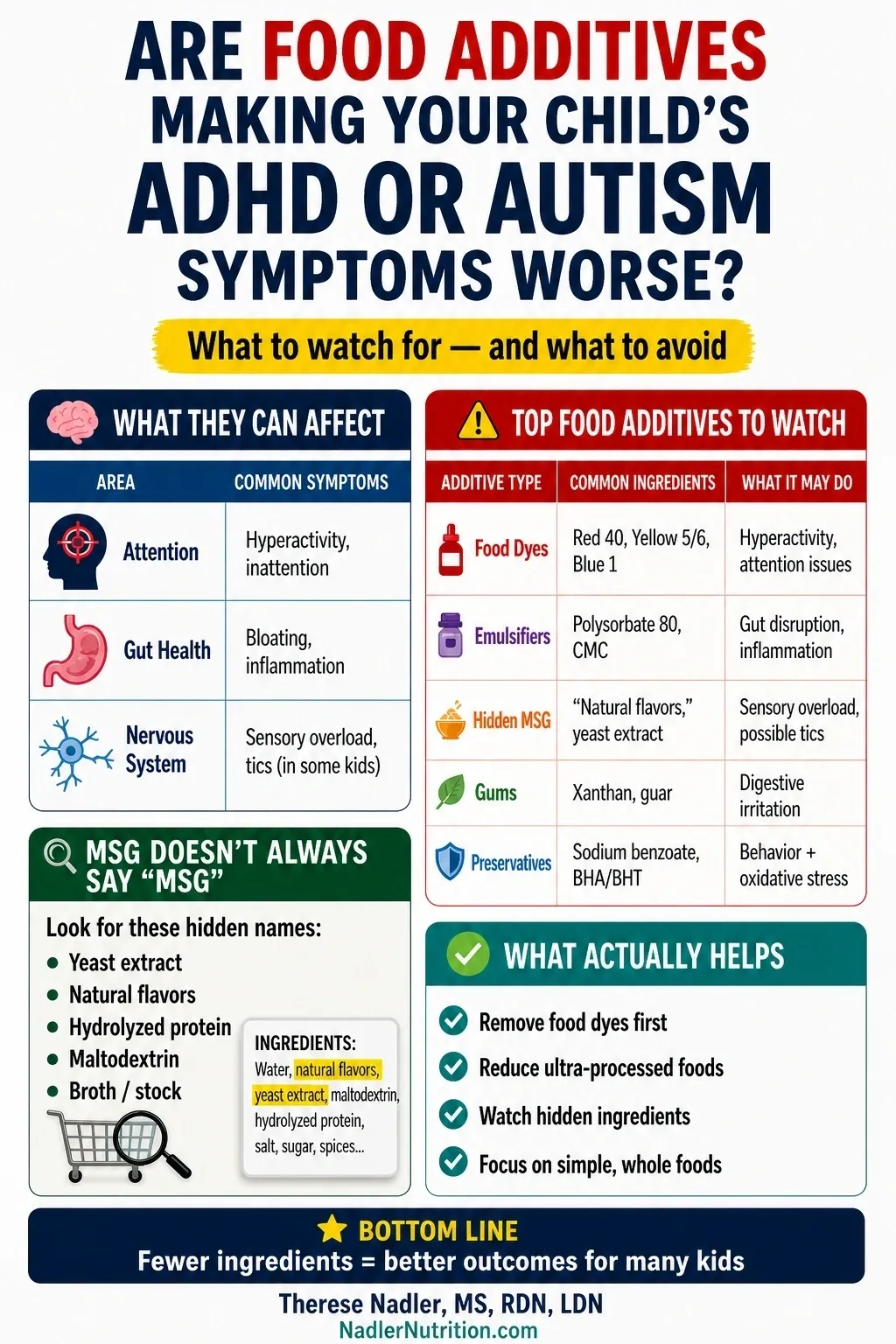
Are food additives making your child’s ADHD or autism symptoms worse?
Emerging research, and what I consistently see in my practice, suggests that certain food additives may worsen symptoms in some children with ADHD and autism. Ingredients like artificial food dyes, preservatives, emulsifiers, and hidden sources of free glutamate (MSG) can negatively affect behavior, attention, and gut health, particularly in children who are more sensitive.
For some kids, these additives are associated with:
- Hyperactivity and inattention
- Mood swings and irritability
- Gut issues (bloating, constipation, diarrhea)
- Sensory dysregulation
- In some cases, motor and vocal tics
This doesn’t apply to every child, but in the right child, removing or reducing these ingredients can be a high-impact, low-risk intervention that supports both brain and body.
In this guide, you’ll learn:
- The most common food additives to watch for
- How to identify them on ingredient labels
- Practical ways to significantly reduce exposure (and what changes actually matter most)
Why Are Kids with ADHD and Autism More Sensitive to Food Additives?
Children with ADHD and autism often have:
- Gut microbiome imbalances
- Higher inflammation
- Differences in detoxification pathways
- Neurotransmitter imbalances (especially glutamate vs. GABA)
What this means: Their systems are more vulnerable to chemical exposures—including food additives.
Which Food Additives Should Parents Avoid for ADHD and Autism?
1. Artificial Food Dyes (Strongest Evidence for Behavior)
Artificial dyes are one of the most well-researched triggers for hyperactivity.
Common dyes:
- Red 40
- Yellow 5
- Yellow 6
- Blue 1
What they may affect:
- Attention
- Impulsivity
- Emotional regulation
What research shows:
- Food dyes are linked to increased hyperactivity in children
- Some countries require warning labels or restrictions
2. Emulsifiers (Gut-Brain Disruptors)
Emulsifiers can damage gut health, which directly impacts brain function.
Common emulsifiers:
- Polysorbate 80
- Carboxymethylcellulose (CMC)
- Carrageenan
What they may affect:
- Gut lining integrity
- Microbiome balance
- Inflammation
Why this matters:
The gut-brain axis plays a major role in both ADHD and autism symptoms.
3. Free Glutamate (MSG and Hidden Sources)
Free glutamate can overstimulate the brain and may worsen behavior, sensory issues, and tics.
What is glutamate?
Glutamate is an excitatory neurotransmitter. Too much can lead to:
- Overstimulation
- Irritability
- Difficulty calming down
Where does MSG hide in foods?
According to your uploaded ingredient list , glutamate is often labeled as:
Direct sources:
- Monosodium glutamate (MSG)
- Glutamic acid (E620–E625)
Hidden sources:
- Yeast extract
- “Natural flavors”
- Hydrolyzed protein
- Soy protein isolate
- Whey protein isolate
- Broth, stock, bouillon
- Maltodextrin
- Modified food starch
- Carrageenan
Can MSG cause tics in kids?
There is no definitive large-scale study proving MSG causes tics, but:
Clinically, many parents and practitioners observe:
- Increased motor tics
- Increased vocal tics
- Heightened sensory reactivity
Why it might happen:
- Excess glutamate → increased neural excitability
- Imbalance with calming neurotransmitter GABA
4. Gums and Thickeners
Gums may worsen gut symptoms and indirectly affect behavior.
Common gums include:
- Xanthan gum
- Guar gum
- Carrageenan
What they may affect:
- Digestion
- Microbiome
- GI comfort
5. Preservatives and Additives That May Affect Behavior
Watch for:
- Sodium benzoate
- BHA / BHT
- Artificial sweeteners (aspartame, sucralose)
Potential effects:
- Oxidative stress
- Gut disruption
- Behavioral changes
What Is the “Total Load” Effect?
It’s not just one ingredient. It’s cumulative exposure across the day.
Example:
- Colored cereal
- Packaged snacks
- Flavored yogurt
- Processed dinner
By the end of the day, the nervous system may be overloaded.
How Do You Reduce Food Additives Without Overwhelm?
Step-by-step approach:
1. Remove artificial food dyes first
Biggest impact for ADHD symptoms
2. Reduce ultra-processed foods
Focus on:
- Whole foods
- Short ingredient lists
3. Watch hidden glutamate sources
Especially:
- “Natural flavors”
- Protein isolates
- Processed snacks
4. Support gut health
- Fiber-rich foods
- Fruits and vegetables
- Anti-inflammatory nutrients
How to Read Labels for Food Additives (Quick Guide)
Avoid foods with:
- Long ingredient lists
- Multiple gums/emulsifiers
- “Flavoring” or “natural flavors”
Bottom line: The fewer ingredients, the better, especially for kids with sensitive systems.
Final Takeaway for Parents
You don’t need to eliminate everything overnight. But for many children with ADHD and autism, reducing food additives can meaningfully improve:
- behavior
- focus
- gut health
- overall regulation
Start with:
- food dyes
- ultra-processed foods
- hidden glutamate sources
For one-to-one guidance, learn how ADHD nutrition for kids works in practice.
You may also find these helpful: Best ADHD Diet for Kids: Foods + Easy Recipes and GFCF Diet for Autism & ADHD: Does It Work?
Citations
- McCann D et al. (2007). Food additives and hyperactive behavior in children. The Lancet
- Nigg JT et al. (2012). Meta-analysis of food color effects on ADHD. JAACAP
- Chassaing B et al. (2015). Emulsifiers and gut microbiota. Nature
- Cryan JF & Dinan TG (2012). Gut-brain axis. Nat Rev Neurosci
- Holton KF et al. (2018). Excitotoxins and neurobehavior
- Samuels A (1999). MSG symptom complex
- Benton D (2008). Artificial food colorings
- Ríos-Covián D et al. (2016). Gut microbiota review
- Wang L et al. (2021). Gut-brain axis in autism
- FDA Food Additive Safety Reports