Mold Illness: Why Detox Fails Without the Right Foundation
If you’ve been exposed to mold and still don’t feel better, even after remediation, you’re not...
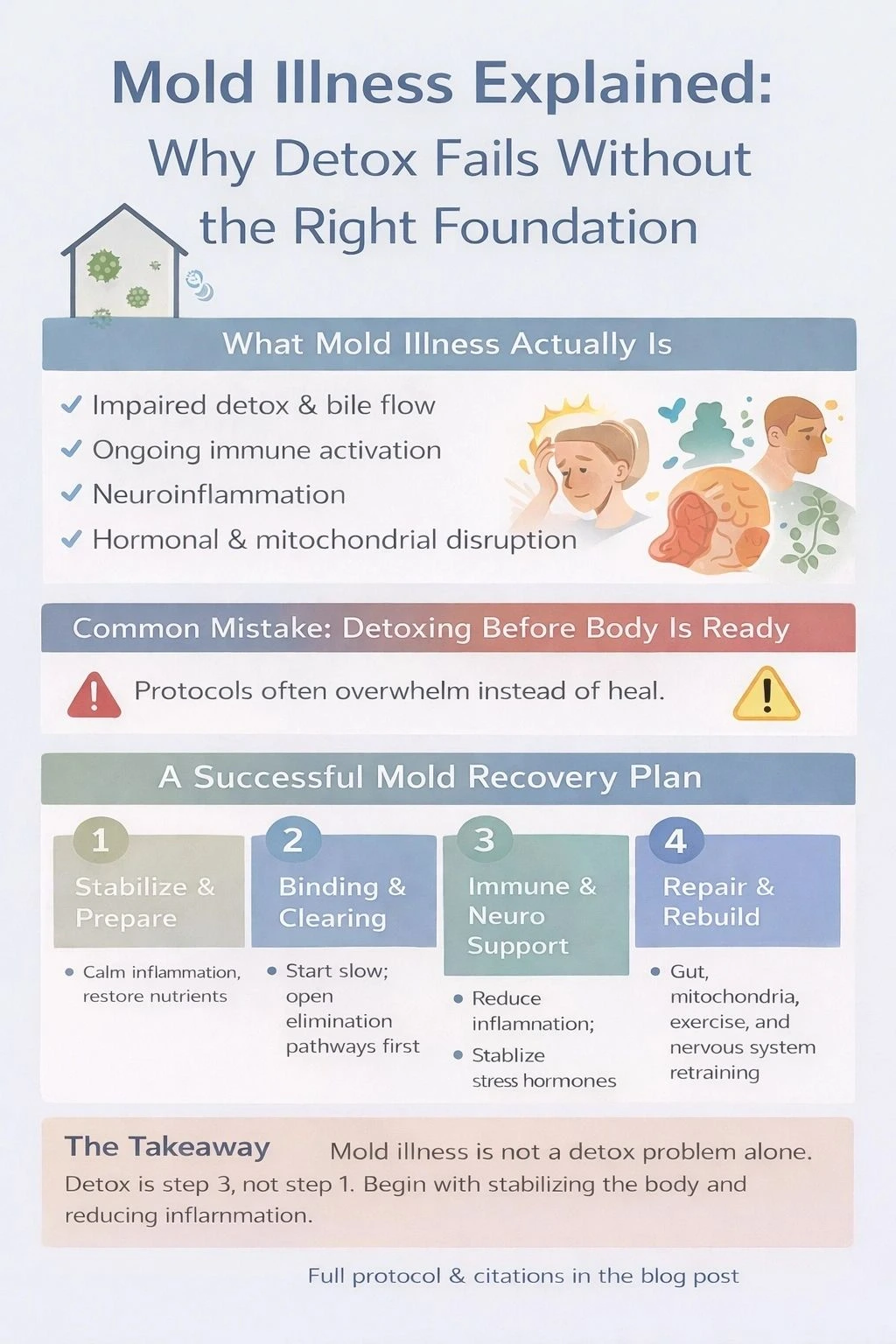
If you’ve been exposed to mold and still don’t feel better, even after remediation, you’re not alone.
One of the biggest misunderstandings about mold illness is the belief that symptoms come from exposure alone. In reality, mold illness develops when the body cannot properly clear biotoxins, leading to chronic immune activation, inflammation, and nervous system disruption.
This is why some people recover quickly after leaving a moldy environment, while others remain sick for months or years.
What Mold Illness Actually Is
Mold illness is not just exposure. It is a systems-level condition involving:
- Impaired detoxification and bile clearance
- Ongoing innate immune activation
- Neuroinflammation and nervous system dysregulation
- Hormonal and mitochondrial disruption
The core issue is failure of clearance, not simply the presence of mold. When mycotoxins recirculate instead of being eliminated, they continue to trigger inflammation even after exposure ends.
Several factors influence this process, including genetics, gut health, nutrient status, stress physiology, and overall metabolic resilience.
Why Many Mold Protocols Fail
A common mistake is starting aggressive detoxification too early.
People often begin binders, saunas, fasting, or high-dose supplements before the body is ready to clear toxins safely. This can worsen symptoms, trigger “crashes,” and delay healing.
Successful mold recovery follows a stepwise sequence:
- Stabilize the system
- Restore drainage and nutrient status
- Bind and clear toxins slowly
- Repair and rebuild
Skipping the first two steps is the most common reason detox fails.
Labs That Matter in Mold Illness (In Order)
Testing helps guide decisions, but more tests do not equal better outcomes. Priority matters.
Tier 1: Foundational Testing
These labs help confirm exposure and explain symptoms:
- Urine mycotoxins (e.g., ochratoxin A, aflatoxins, trichothecenes)
- Inflammatory markers (TGF-β1, C4a, MMP-9, VEGF, hs-CRP)
- Basic bloodwork: CMP, CBC, ferritin, B12, folate, vitamin D, magnesium, zinc, copper
- Full thyroid panel (mold frequently suppresses thyroid signaling)
Tier 2: Functional Insight
- Stool testing (gut integrity and bile flow are critical for detox)
- Organic Acids Test (mitochondrial stress, glutathione demand, oxidative burden)
- Cortisol rhythm testing (chronic mold stress disrupts HPA axis signaling)
Advanced testing (HLA susceptibility, MARCoNS, VCS) can be helpful in select cases but is not required for everyone.
Common Nutrient Depletions in Mold Illness
These deficiencies are pattern-consistent, not random:
Most common:
- Magnesium
- Zinc
- Vitamin C
- Glutathione (or precursors)
- B6 and B12
- Omega-3 fatty acids
- Iron (often functional deficiency)
Often overlooked:
- Choline (critical for bile flow)
- Molybdenum (aldehyde and fungal byproducts)
- Selenium (thyroid and antioxidant enzymes)
- Glycine (phase II detox and sleep support)
Correcting these deficits often improves symptoms before detox even begins.
The Best-Practice Mold Recovery Approach (Stepwise)
Step 1: Stabilize and Prepare (2–6 Weeks)
Goals
- Calm inflammation
- Support bile flow and elimination
- Replete depleted nutrients
- Improve sleep and stress tolerance
Key principles
- Avoid fasting early
- Avoid aggressive sauna use
- Focus on gentle movement only
- Prioritize sleep before 11 pm
Diet should be whole-food, anti-inflammatory, protein-forward, and not ketogenic early in recovery.
Step 2: Binding and Clearing (Slow and Strategic)
Binders are tools, not cures.
Common options include:
- Activated charcoal
- Bentonite clay
- Modified citrus pectin
- Prescription bile acid sequestrants (when appropriate)
Critical rules
- Always away from food and supplements
- Ensure daily bowel movements
- Start 2–3 times per week, not daily
- Rotate binders rather than stacking
Rushing this step is the fastest way to regress.
Step 3: Immune and Nervous System Support
As toxin burden decreases, many people experience noticeable improvement when supporting:
- Omega-3 fatty acids
- Curcumin and polyphenols
- Quercetin (histamine regulation)
- L-theanine or GABA for anxiety-dominant patterns
Adaptogens should be used cautiously, as mold-sensitive individuals often react.
Step 4: Repair and Rebuild
Once mycotoxin levels decline:
- Gut repair becomes effective
- Mitochondrial support improves stamina
- Exercise tolerance gradually returns
- Nervous system retraining becomes essential
At this stage, healing accelerates but only if earlier steps were respected.
Pediatric Mold Illness: A Different Rulebook
In children, neuroregulation comes before detox.
Aggressive detoxification can worsen anxiety, rigidity, tics, and sensory symptoms. Many children improve significantly once:
- Minerals are repleted
- Sleep and routines stabilize
- Gut comfort improves
- Ongoing exposure is removed
Gentle binding may be introduced later, only if the child is stable.
Why Adults Often Stay Sick After Remediation
Even after leaving a moldy environment, adults may remain symptomatic due to:
- Residual toxin recirculation through bile
- Depleted detox capacity
- Persistent immune activation
- Nervous system hypervigilance
Without addressing drainage, nutrient repletion, and nervous system safety, detox stalls.
The Most Important Takeaway
Mold illness is not a detox problem alone.
It is a condition of:
- Impaired clearance
- Immune overactivation
- Nutrient depletion
- Nervous system threat signaling
Protocols that prioritize stabilization, bile flow, minerals, and nervous system safety before detoxification are consistently more successful and better tolerated.
Frequently Asked Questions (AEO)
Can mold illness improve without detox? Yes. Many symptoms improve significantly with stabilization, nutrient repletion, and reduced exposure before binders are introduced.
Why do people crash during mold detox? Detox is started before elimination pathways are ready, leading to toxin redistribution instead of clearance.
How long does mold recovery take? Mild cases may improve in 3 – 6 months. Moderate to severe cases often require 6 – 18 months with a stepwise approach.
Explore related articles on my site about nutrition: How Gut Health Impacts Behavior in Kids, How to Manage Picky Eating, Tackling Toddler Constipation and more.
Written by Therese Nadler MS, RDN, LDN Functional & Integrative Registered Dietitian Nutritionist (RDN)
References
- Brewer JH et al. Chronic illness associated with mold and mycotoxins: is nasosinusal fungal biofilm the culprit? Toxins. 2013.
- Shoemaker RC et al. Chronic inflammatory response syndrome. Surv Ophthalmol. 2010.
- Pestka JJ. Mechanisms of mycotoxin-induced immune modulation. Toxicol Lett. 2008.
- Maes M et al. Neuroimmune toxicity in chronic fatigue and inflammatory illness. Mol Neurobiol. 2013.
- Smith M, Boeckh A. Mycotoxins, mitochondrial dysfunction, and oxidative stress. Environ Health Perspect.
- Morris G, Berk M. The role of the nervous system in chronic inflammatory illness. Mol Neurobiol.