ARFID in Children: Symptoms, Diagnosis & Treatment
Avoidant/Restrictive Food Intake Disorder (ARFID) is more than picky eating. It is a diagnosable feeding disorder...
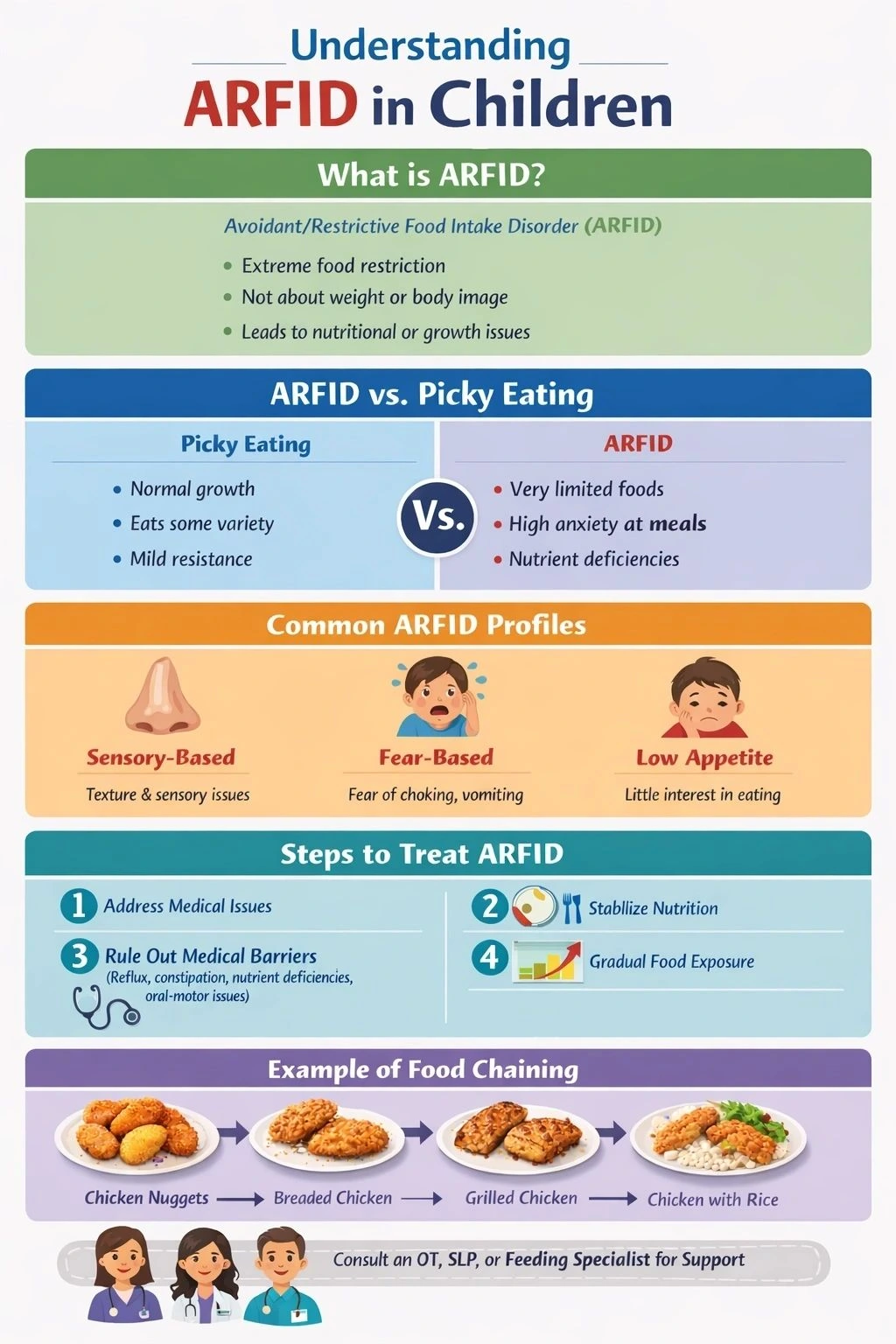
Avoidant/Restrictive Food Intake Disorder (ARFID) is more than picky eating. It is a diagnosable feeding disorder that can affect a child’s nutrition, growth, emotional well-being, and family life.
Parents are often told their child will “grow out of it,” yet ARFID typically does not resolve without targeted support. Understanding what ARFID is and how it’s treated can make all the difference.
This guide explains:
- What ARFID is and how it’s diagnosed
- How ARFID differs from picky or selective eating
- The step-by-step treatment approach that works
- Real-life food chaining examples
- When to involve an OT, SLP, or feeding specialist
- How ARFID is often connected to autism, ADHD, and anxiety
What Is ARFID?
Avoidant/Restrictive Food Intake Disorder (ARFID) is a feeding and eating disorder defined by persistent avoidance or restriction of food that leads to nutritional, medical, or psychosocial consequences.
ARFID was officially recognized in the DSM-5 (2013) and updated in the DSM-5-TR (2022).
Key features of ARFID:
- Severe restriction in food variety, volume, or both
- Avoidance driven by sensory sensitivity, fear, or low appetite
- No concern about body weight or shape
- Interference with growth, nutrition, or daily life
ARFID is not behavioral defiance. It is driven by the nervous system, sensory processing, and learned fear responses.
How Is ARFID Diagnosed?
ARFID is diagnosed clinically, not through a single lab test.
A child may meet criteria if restrictive eating leads to one or more of the following:
- Poor weight gain or weight loss
- Nutrient deficiencies
- Reliance on supplements or tube feeding
- Significant stress or disruption to family and social functioning
And the eating difficulty:
- Is not due to lack of food access
- Is not explained by cultural practices
- Is not related to body image or dieting
Diagnosis is often made by pediatricians, psychologists, psychiatrists, or multidisciplinary feeding teams.
ARFID vs. Picky Eating: What’s the Difference?
This distinction is critical for choosing the right intervention.
Typical Picky Eating:
- Common in toddlers and preschoolers
- Child eats enough calories to grow
- Food variety slowly improves
- Mild resistance, little anxiety
ARFID:
- Extremely limited food list (often under 10–15 foods)
- Foods may be dropped over time
- Strong anxiety, fear, or distress around eating
- Growth or nutritional concerns are common
- Family life revolves around managing meals
Picky eating is a phase. ARFID is a feeding disorder.
The 3 Most Common ARFID Profiles
Most children with ARFID fit into one primary profile, though overlap is common.
1. Sensory-Based ARFID
- Avoidance due to texture, smell, appearance, or temperature
- Preference for uniform or “beige” foods
- Common in autistic and sensory-sensitive children
2. Fear-Based ARFID
- Triggered by choking, vomiting, reflux, or illness
- Eating becomes associated with danger
- High anticipatory anxiety around meals
3. Low Interest / Low Appetite ARFID
- Limited hunger cues
- Early satiety or forgetting to eat
- Often seen with neurodivergence, chronic illness, or stimulant medications
Identifying the profile always guides treatment.
ARFID, Autism, ADHD, and Anxiety: How They’re Connected
ARFID frequently overlaps with neurodevelopmental and anxiety conditions.
ARFID and Autism
- Sensory sensitivities are a major driver
- Rigid food rules and strong preferences are common
- Interoceptive awareness (hunger/fullness) may be reduced
ARFID and ADHD
- Low appetite from stimulant medications
- Difficulty with interoception and body cues
- Executive functioning challenges around meals
ARFID and Anxiety
- Fear-based ARFID is fundamentally an anxiety response
- Avoidance is reinforced when eating feels unsafe
- Generalized anxiety or OCD traits may coexist
In many cases, ARFID is not separate from these conditions. It is one way they show up around food.
Treatment must address both feeding and the nervous system, not just food exposure.
How ARFID Is Treated: A Step-by-Step Approach
There is no single treatment that works alone. Effective ARFID care is multidisciplinary and gradual.
Step 1: Rule Out Medical Contributors
Before working on behavior, address physical drivers:
- Reflux (including silent reflux)
- Constipation
- Iron, zinc, B12, vitamin D deficiencies
- Food intolerances causing pain or nausea
- Oral-motor fatigue or chewing difficulty
- Medication side effects
Pain + hint: if eating hurts, avoidance becomes protective.
Step 2: Stabilize Nutrition First
The goal is nutritional safety, not immediate variety.
- Keep safe foods available
- Use supplements when intake is inadequate
- Maintain predictable meal and snack timing
- Avoid removing preferred foods prematurely
Step 3: Desensitization and Exposure (Done Correctly)
Exposure works well only when it feels safe.
Effective exposure:
- Is predictable and gradual
- Respects the child’s control
- Measures success by tolerance, not bites
Progression may include:
- Looking → touching → smelling → tasting → swallowing
Forced exposure increases anxiety and backfires long-term.
Step 4: Food Chaining (Gold-Standard Strategy)
Food chaining expands diets by making tiny, logical changes from accepted foods.
Rules:
- Change only one variable at a time
- Use familiar foods as bridges
- Expect progress over weeks to months
Real-Life Food Chaining Examples
1. Crackers
Goldfish → Whole-grain crackers → Toasted bread squares → Bread cubes → Sandwich bites
2. Chicken
Chicken nuggets → Baked breaded chicken fingers/cutlets → Grilled chicken → Chicken mixed into pasta or rice
3. Potatoes
French fries → Baked wedges → Mashed potatoes → Mashed potatoes + cauliflower → Roasted cauliflower
4. Smoothies
Yogurt → Yogurt smoothies → Fruit smoothies with yogurt → Fruit smoothies → Green smoothies
5. Applesauce
Applesauce → Applesauce + cinnamon → Applesauce + pear → Thick blended fruit → Fruit dip with crackers or apples
6. Nut Butters
Peanut butter → PB + honey → PB thinned with milk or yogurt → Protein dip for fruit or crackers
7. Pasta
Plain pasta → Pasta with butter → Pasta with butter + parmesan → Mild sauce → Sauce with protein mixed in
When to Involve an OT, SLP, or Feeding Specialist
You should seek feeding therapy if a child:
- Eats fewer than ~15 foods
- Has growth or nutrient concerns
- Gags, chokes, or fatigues while eating
- Shows escalating anxiety around meals
- Is not progressing with home strategies
Who does what?
- Occupational Therapist (OT): sensory regulation, tolerance, posture
- Speech-Language Pathologist (SLP): chewing, swallowing, oral-motor skills
- Feeding therapist: integrated sensory-behavioral work
- Dietitian: nutrition adequacy, food chaining, supplementation
The best outcomes come from coordinated care, not siloed treatment.
What Progress Looks Like in ARFID Treatment
Success is not “eating everything.”
Real progress includes:
- Less anxiety at meals
- Tolerating new foods on the plate
- Touching or smelling new foods
- Gradual expansion of food categories
- Improved family routines
Regression during illness or stress is normal.
Takeaway
ARFID is not picky eating, not bad parenting, and not something children just “grow out of.”
It is a neurobiological feeding disorder that responds best to:
- Medical evaluation
- Nutritional stabilization
- Gradual exposure
- Food chaining
- Anxiety-informed care
- Team-based support
With the right approach, children can and do expand their diets safely and sustainably.
Explore related articles on my site about nutrition for Autism and ADHD, How Gut Health Impacts Behavior in Kids, How to Manage Picky Eating, Tackling Toddler Constipation and more.
If your child fits the ARFID picture described here, structured help works better than waiting it out. My ARFID support services combine nutrition stabilization, food chaining, and anxiety-informed feeding work, and my step-by-step food chaining guide shows what the home-side work looks like. You can also book a free discovery call to talk through where your child is right now.
This article is for educational purposes only and is not medical advice or a substitute for individualized care. ARFID is a clinical diagnosis; for concerns about your child’s eating, growth, or nutrition, consult your pediatrician or a registered dietitian.
Written by Therese Nadler MS, RDN, LDN Functional & Integrative Registered Dietitian Nutritionist (RDN)
References
- American Psychiatric Association. DSM-5-TR.
- Thomas JJ, Eddy KT. Cognitive Behavioral Therapy for ARFID. Cambridge University Press.
- Fraker C et al. Food Chaining. Da Capo Press.
- Sharp WG et al. Feeding problems in ARFID. Journal of Pediatrics.
- Bryant-Waugh R et al. Feeding disorders in childhood. Current Psychiatry Reports.
- American Academy of Pediatrics. Pediatric feeding disorder guidelines.