Picky Eating vs ARFID in Kids: Signs, Solutions, How to Get Help
Overview This article explores the difference between picky eating, extreme picky eating, and ARFID. It explains...
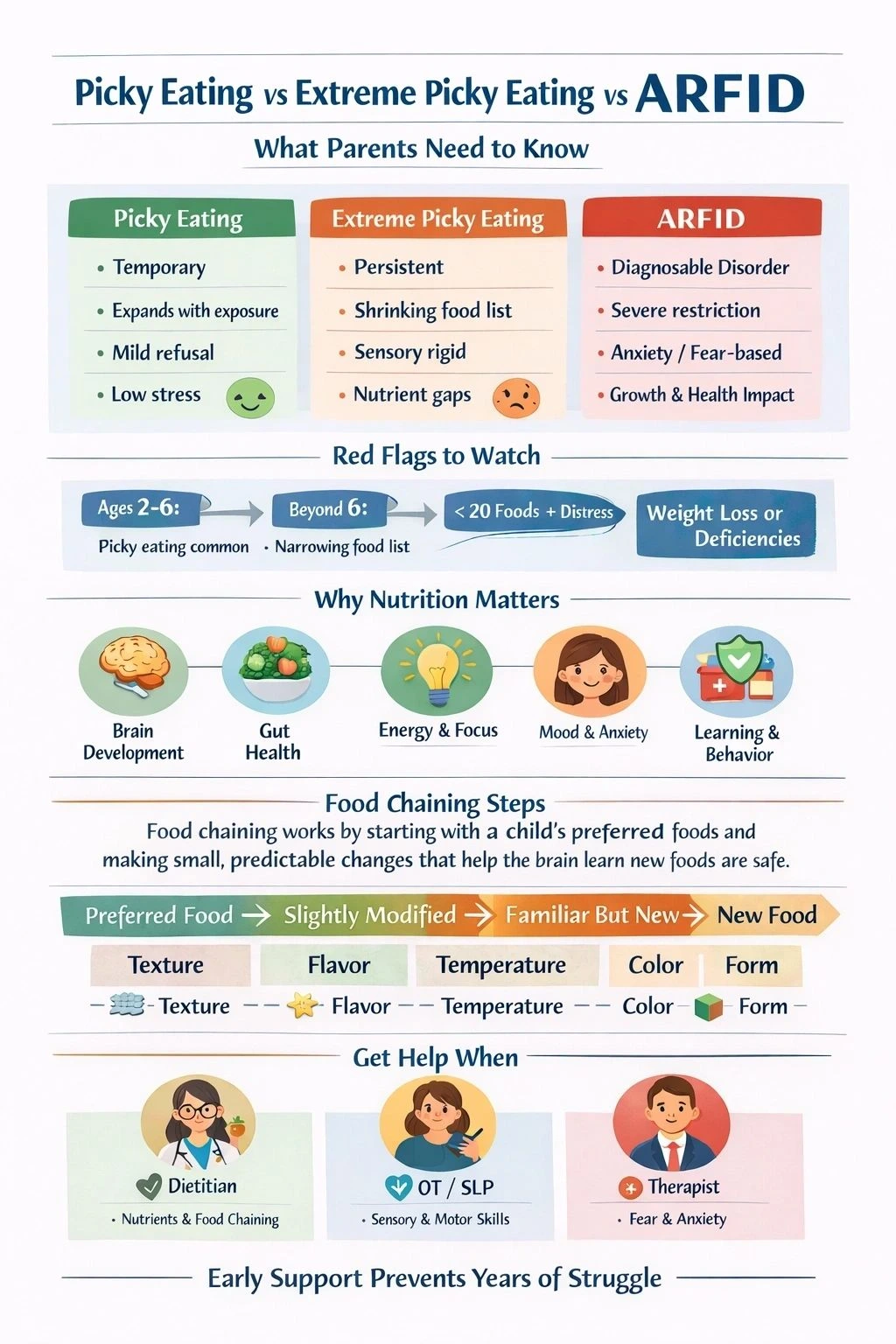
Overview This article explores the difference between picky eating, extreme picky eating, and ARFID. It explains how to understand the warning signs, nutritional risks associated with each condition, and realistic food-chaining strategies that actually help kids expand their diet.
Introduction
Picky eating is common in young children and often improves with time and exposure. Extreme picky eating is persistent and restrictive and may affect nutrition and behavior. ARFID is a diagnosable feeding disorder that requires professional support and can impact growth, mental health, and family life.
Why This Matters More Than Most Parents Are Told
Many parents are reassured that picky eating is “normal.” While that can be true early on, persistent restrictive eating affects far more than meals. Research links long-term selective eating to:
- nutrient deficiencies (iron, zinc, fiber, B-vitamins)
- gut microbiome imbalance
- anxiety and emotional dysregulation
- poor energy, focus, and behavior
- long-term feeding disorders
Waiting too long is one of the biggest reasons picky eating becomes harder to treat later.
What Is Picky Eating? (Definition + Signs)
Picky eating refers to a temporary developmental phase, most common between ages 2–6, where children:
- prefer familiar (often beige) foods
- resist new foods (food neophobia)
- reject vegetables or mixed textures or different foods touching
Key idea: The food list may fluctuate but does not continue shrinking over time.
What’s happening biologically
- Heightened taste sensitivity (especially to bitter compounds)
- Normal evolutionary preference for familiarity (and often sweeter foods)
- Immature sensory processing systems
Repeated neutral exposure helps children adapt. Lack of exposure reinforces avoidance.
When picky eating becomes concerning:
- lasts beyond early childhood (age 6 or 7 years old)
- creates stress or power struggles
- leads to nutritional gaps
Why age 6–7 is a meaningful marker
Typical picky eating peaks between ages 2–5 and often improves naturally as:
- sensory tolerance increases
- oral-motor skills mature
- social eating expands (school, peers, parties, etc.)
By age 6–7, most children:
- have expanded food variety
- can tolerate mixed textures
- can eat across food groups
- can deal with foods touching/co-mingling on a plate or in a bowl
Persistence past this window suggests the issue is no longer developmental alone.
Research supports picky eating which persists into school age children is more likely to:
- remain stable over time
- be associated with anxiety traits
- be linked to nutritional inadequacy
Bottomline:
While picky eating is common in early childhood, it becomes more concerning when restrictive patterns persist beyond ages 6–7 or when food variety continues to narrow, nutritional adequacy is compromised, or mealtimes cause distress at any age.
What Is Extreme Picky Eating?
Extreme picky eating is not a diagnosis, but it signals that eating patterns are becoming entrenched.
Common signs parents notice:
- fewer than ~20 accepted foods
- refusal of entire food groups (vegetables, proteins)
- intense reactions to food changes
- brand, color, or preparation rigidity
- meals dominated by refined carbohydrates
These children often have:
- sensory sensitivities
- anxiety traits
- ADHD or autism
- early feeding challenges (reflux, choking, prematurity)
Important: Extreme picky eating does not usually resolve on its own without structured support.
What Is ARFID? (Avoidant/Restrictive Food Intake Disorder)
ARFID is a clinical feeding disorder recognized in the DSM-5-TR.
ARFID is defined by:
- restricted intake that fails to meet nutritional needs
- weight loss, poor growth, or nutrient deficiencies
- dependence on supplements or formulas
- significant psychosocial disruption
ARFID does NOT involve body image or weight concerns.
Common ARFID profiles:
- Sensory-based avoidance (texture, smell, appearance)
- Fear-based avoidance (choking, vomiting, allergic reactions)
- Low appetite or low interest in eating
ARFID frequently co-occurs with autism, ADHD, anxiety, and GI conditions.
Why Nutrition Quality Matters (Even If Calories Are “Enough”)
Children with restricted diets often meet calorie needs but miss key nutrients required for:
- brain development (iron, zinc, DHA, B-vitamins)
- adequate neurotransmitter production
- immune resilience (catch colds, bugs, flus often)
- gut-brain signaling
Low fiber diversity reduces beneficial gut bacteria and short-chain fatty acids like butyrate, which influence inflammation and mood.
When Parents Should Seek Additional Help
Seek professional support if your child:
- eats fewer than 15–20 foods
- avoids entire food groups
- gags, panics, or shuts down around food
- shows stalled progress for 6+ months
- has nutrient deficiencies or poor growth
- experiences anxiety before/during meals
Who to involve (and why):
- Pediatric Dietitian (feeding-informed): nutrient adequacy, food chaining
- Feeding Therapist (OT or SLP): sensory and oral-motor support
- Mental Health Professional (CBT-AR): fear-based avoidance and anxiety
Early, multidisciplinary care leads to better outcomes.
Realistic Food Chaining Strategies (That Actually Work)
Food chaining works by changing one variable at a time:
- texture
- flavor
- temperature
- form
- visibility
The goal is neural familiarity, not “perfect” eating.
Food Chain Example: Beige Foods → Green Smoothies
Starting foods: applesauce, muffins, pancakes
- Applesauce (plain)
- Applesauce + mashed pear
- Applesauce + mashed pear + 1 tsp diluted white grape juice
- Applesauce + mashed pear + 1 tsp diluted green juice
- Frozen smoothie popsicle
- Fruit smoothie with micro-amount of spinach or microgreens
- Green smoothie with blended greens
*Cold + sweet reduces bitterness **Freezing lowers sensory intensity
Food Chain Example: Pasta → Broccoli / Cauliflower
- Plain pasta
- Pasta + butter + a few breadcrumbs
- Pasta + breadcrumb topping + powdered cauliflower
- Pasta with blended cauliflower cheese sauce
- Pasta with finely minced roasted broccoli
- Larger mixed florets
- Broccoli on the side
*Powdered vegetables often create less resistance because they don’t significantly change the taste, texture, or appearance of familiar foods, allowing the brain to register the food as safe while still increasing exposure.
What Parents Can Do Right Now
- Serve at least one safe food per meal
- Add one exposure food. Remember: no pressure.
- Keep meals predictable
- Remove commentary (“just try it” or “please take one bite”)
- Track progress monthly, not daily
Progress = less fear, not more bites.
Bottom Line for Parents
Picky eating is not about stubbornness. It’s about biology, sensory systems, and learned safety. With the right strategies and early support, children can expand their diets, and the sooner you act, the easier it is.
Explore related articles on my site about nutrition for Autism and ADHD, How Gut Health Impacts Behavior in Kids, How to Manage Picky Eating, Tackling Toddler Constipation and more.
Written by Therese Nadler MS, RDN, LDN Functional & Integrative Registered Dietitian Nutritionist (RDN)
References
- American Psychiatric Association. DSM-5-TR (2022)
- Birch LL, Fisher JO. Appetite (1998)
- Cardona Cano S et al. J Am Acad Child Adolesc Psychiatry (2015)
- Cryan JF et al. Physiol Rev (2019)
- Kambanis PE et al. Curr Psychiatry Rep (2020)
- Mascola AJ et al. Clin Pediatr (2010)
- Taylor CM et al. Proc Nutr Soc (2015)
- Thomas JJ et al. Curr Psychiatry Rep (2020)