Menopause Weight Gain: Causes and How to Lose Belly Fat After 40
Why Am I Gaining Weight During Menopause? If you feel like your body has changed overnight,...
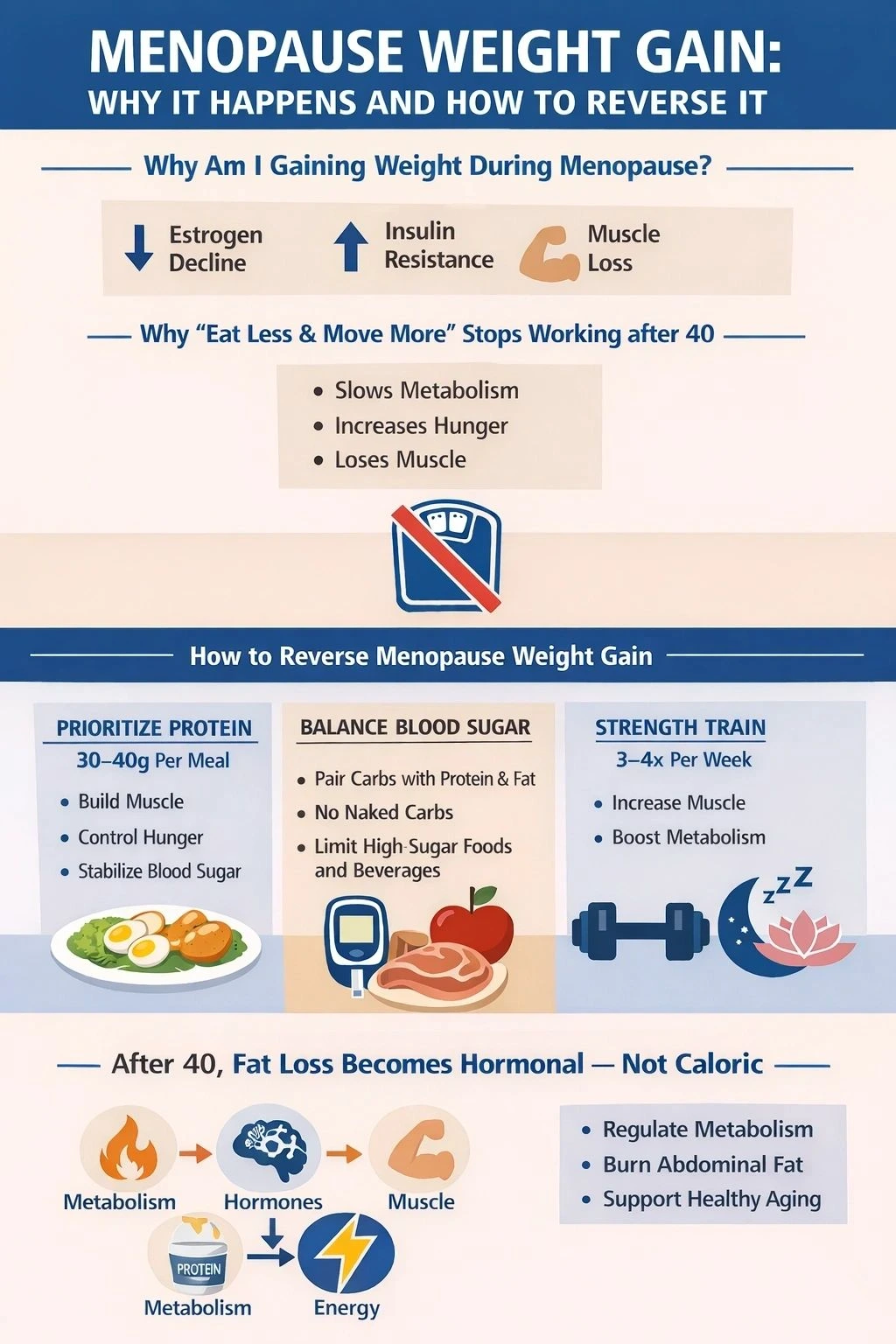
Why Am I Gaining Weight During Menopause?
If you feel like your body has changed overnight, especially around your midsection, you are not imagining it.
Menopause weight gain is not just about eating more or exercising less. It is driven by real physiological changes that affect fat storage, metabolism, and hormones.
The three biggest drivers are:
- Estrogen decline
- Insulin resistance
- Muscle loss
1. Estrogen Decline Increases Belly Fat
As estrogen drops, fat storage shifts to the abdomen. This leads to an increase in visceral fat, which surrounds internal organs and contributes to metabolic dysfunction.
This is why many women notice:
- Increased belly fat
- A thicker waistline
- A change in body composition
2. Insulin Resistance Makes Fat Loss Harder
Lower estrogen reduces insulin sensitivity. This leads to:
- Higher blood sugar spikes
- Increased insulin levels
- Greater fat storage
Even if your diet has not changed, your metabolism has.
3. Muscle Loss Slows Your Metabolism
After 40, muscle mass declines more rapidly. Muscle is essential for:
- Burning calories
- Stabilizing blood sugar
- Maintaining strength
Less muscle = slower metabolism + easier fat gain
Why “Eat Less” Stops Working After 40
Traditional dieting often leads to:
- Muscle loss
- Increased hunger
- Slower metabolism
The real issue is not calories. It’s hormones and metabolic function.
How to Reverse Menopause Weight Gain
Prioritize Protein (30–40g Per Meal)
Protein helps:
- Preserve muscle
- Improve satiety
- Stabilize blood sugar
Aim for:
- 30–40 grams per meal
- 90–120g per day (depending on body size)
Stabilize Blood Sugar
To reduce fat storage:
- Pair carbs with protein and fat
- Avoid high-sugar, refined foods
- Eat balanced meals
Stable blood sugar = better energy + easier fat loss
Strength Train 3–4x Per Week
Resistance training:
- Preserves muscle
- Improves insulin sensitivity
- Increases metabolism
Improve Sleep and Circadian Rhythm
Poor sleep increases:
- Hunger
- Cravings
- Fat storage
Focus on:
- Consistent sleep schedule
- Morning sunlight exposure
- Reducing nighttime screen use
Manage Stress and Cortisol
Chronic stress promotes:
- Belly fat storage
- Blood sugar imbalance
- Sleep disruption
Bottom Line
Menopause weight gain is biological, not a lack of discipline.
The solution is to:
- Increase protein
- Stabilize blood sugar
- Build muscle
- Support sleep and stress
Key Takeaway
After 40, your body is not broken but it is operating under a new set of rules.
When you understand those rules, fat loss becomes possible again.
FAQs
Why do women gain weight during menopause?
Hormonal changes, especially declining estrogen, lead to increased fat storage, insulin resistance, and muscle loss, all of which contribute to weight gain.
Why is belly fat more common after 40?
Lower estrogen shifts fat storage to the abdomen and increases visceral fat, which is more metabolically active.
How much protein do women need during menopause?
Most women benefit from 30–40 grams of protein per meal, totaling around 90–120 grams per day depending on body size and activity level.
Can you lose menopause weight gain?
Yes. By focusing on protein intake, blood sugar control, strength training, and sleep, women can improve body composition and lose fat.
Does poor sleep cause weight gain during menopause?
Yes. Poor sleep disrupts hormones that regulate hunger and metabolism, leading to increased cravings and fat storage.
Explore related articles about wellness, nutrition, gut health, stress, burnout, and more.
If the scale won’t budge despite your best efforts, learn how menopause weight loss nutrition works.
Written by Therese Nadler MS, RDN, LDN, founder/owner of Nadler Nutrition, a pediatric and women’s health nutrition practice based in Annapolis, Maryland, serving patients throughout the Washington DC and Baltimore areas, with telehealth appointments available.
References
- Lovejoy JC, Champagne CM, de Jonge L, Xie H, Smith SR. Increased visceral fat and decreased energy expenditure during the menopausal transition. Obesity Reviews. 2008;9(2):119–126.
- Davis SR, Castelo-Branco C, Chedraui P, et al. Understanding weight gain at menopause. Climacteric. 2012;15(5):419–429.
- Toth MJ, Tchernof A, Sites CK, Poehlman ET. Effect of menopausal status on body composition and abdominal fat distribution. J Clin Endocrinol Metab. 2000;85(7):2376–2381.
- Carr MC. The emergence of the metabolic syndrome with menopause. J Clin Endocrinol Metab. 2003;88(6):2404–2411.
- Mauvais-Jarvis F. Sex differences in metabolic homeostasis, diabetes, and obesity. Endocrine Reviews. 2015;36(3):356–398.
- Kahn SE, Hull RL, Utzschneider KM. Mechanisms linking obesity to insulin resistance and type 2 diabetes. Nature. 2006;444(7121):840–846.
- Wolfe RR. The underappreciated role of muscle in health and disease. Am J Clin Nutr. 2006;84(3):475–482.
- Mitchell WK, Williams J, Atherton P, et al. Sarcopenia, dynapenia, and the impact of advancing age on human skeletal muscle size and strength. J Appl Physiol. 2012;113(7):1163–1171.
- Paddon-Jones D, Rasmussen BB. Dietary protein recommendations and the prevention of sarcopenia. Am J Clin Nutr. 2009;87(5):1562S–1566S.
- Phillips SM, Chevalier S, Leidy HJ. Protein “requirements” beyond the RDA: implications for optimizing health. Appl Physiol Nutr Metab. 2016;41(5):565–572.
- Moore DR, Churchward-Venne TA, Witard O, et al. Protein ingestion to stimulate muscle protein synthesis requires greater relative intake in older adults. J Gerontol A Biol Sci Med Sci. 2015;70(1):57–62.
- Leidy HJ, Clifton PM, Astrup A, et al. The role of protein in weight loss and maintenance. Am J Clin Nutr. 2015;101(6):1320S–1329S.
- Ludwig DS. The glycemic index: physiological mechanisms relating to obesity, diabetes, and cardiovascular disease. JAMA. 2002;287(18):2414–2423.
- Hall KD, Ayuketah A, Brychta R, et al. Ultra-processed diets cause excess calorie intake and weight gain. Cell Metabolism. 2019;30(1):67–77.
- Spiegel K, Leproult R, Van Cauter E. Impact of sleep debt on metabolic and endocrine function. The Lancet. 2004;354(9188):1435–1439.
- Taheri S, Lin L, Austin D, Young T, Mignot E. Short sleep duration is associated with reduced leptin and increased ghrelin. PLoS Medicine. 2004;1(3):e62.
- Westcott WL. Resistance training is medicine: effects on health. Curr Sports Med Rep. 2012;11(4):209–216.
- Strasser B, Schobersberger W. Evidence for resistance training as a treatment therapy in obesity. J Obes. 2011;2011:482564.