PANS and PANDAS: Root Causes Beyond Infection
PANS and PANDAS are neuroimmune disorders driven by immune dysregulation, genetics, and neuroinflammation—not infection alone. Why...
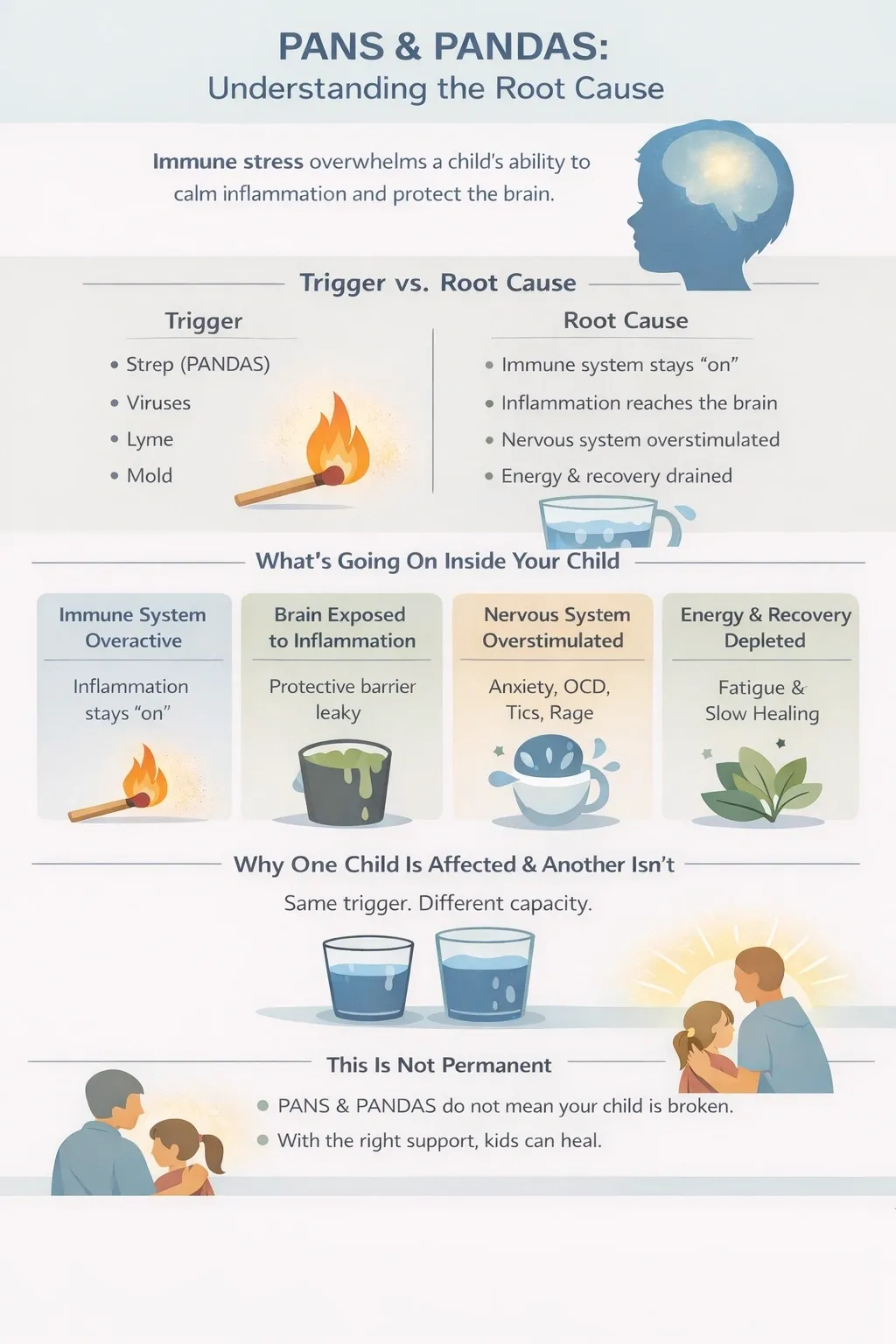
PANS and PANDAS are neuroimmune disorders driven by immune dysregulation, genetics, and neuroinflammation—not infection alone.
Why Infection Alone Isn’t the Whole Story
If your child has been diagnosed with PANS or PANDAS, you were likely told it began with an infection.
For PANDAS, that trigger is often strep. For PANS, triggers can include viruses, bacteria, Lyme, mold, or other immune stressors.
But many parents quickly realize something doesn’t add up:
Why does one child recover normally from an infection while another develops sudden anxiety, OCD, tics, rage, or regression?
That question points directly to the root cause of PANS and PANDAS, and the answer goes beyond infection alone.
Often, the root cause is immune dysregulation that allows inflammation to affect the brain after infection or immune stress.
PANS and PANDAS happen when:
- An infection or immune stressor activates the immune system
- The immune response doesn’t calm down properly
- Inflammation reaches the brain
- The nervous system becomes overwhelmed
The infection is the trigger. The root cause is how your child’s body handles immune stress and recovery.
Think of PANS and PANDAS as “System Overload”
Rather than one single problem, PANS and PANDAS are best understood as several systems getting overloaded at the same time.
1. The Immune System Stays Switched On
In many children with PANS or PANDAS, the immune system remains active even after the infection has passed.
Ongoing immune signals can affect:
- Mood and anxiety
- Behavior and emotional control
- Sleep and attention
- OCD symptoms and tics
This doesn’t mean your child is weak or broken. It means their immune system struggles to fully turn inflammation off once it’s been activated.
2. Inflammation Affects the Brain
The brain is normally protected by a barrier that keeps immune signals out.
During illness and inflammation, that barrier can loosen temporarily. When this happens:
- Immune chemicals reach the brain
- Brain inflammation increases
- Symptoms can appear suddenly and intensely
This explains why PANS and PANDAS symptoms often seem to come on overnight, rather than slowly over time.
3. The Nervous System Becomes Overstimulated
Inflammation disrupts how the brain regulates chemicals involved in: anxiety, compulsions, tics, emotional outbursts, and sleep regulation.
One key piece parents often don’t hear about is histamine.
Histamine isn’t just related to allergies—it also affects:
- Anxiety and panic
- Irritability and rage
- Wakefulness and sleep
- Obsessive thinking
If a child has trouble clearing histamine and stress chemicals, their nervous system can stay stuck in high-alert mode, even after the trigger is gone.
4. Recovery Systems Get Drained
Fighting infection and inflammation uses a lot of energy.
In children with PANS or PANDAS, immune stress can overwhelm the body’s ability to:
- Make enough cellular energy
- Calm inflammation efficiently
- Reset the nervous system
This can show up as: fatigue or brain fog, regression, increased sensory sensitivity, and slower recovery between flares.
This is reversible overload, not permanent damage.
Where Genetics Fit In
Parents often hear about genetics and worry their child is “stuck this way.”
Here’s the reassuring truth:
- Genetics do not cause PANS or PANDAS.
- Genetics influence how much stress a child can handle before symptoms appear.
Some children simply:
- Need more support during illness
- Burn through nutrients faster
- Take longer to recover from immune stress
Think of genetics like cup size:
- Immune stress fills the cup
- Some cups overflow faster
- The goal is to reduce what’s pouring in and strengthen the cup
What Parents Should Focus On First
Instead of chasing one single cause, the most effective approach supports the whole system.
The four most important areas:
Address the trigger
Treat infections or immune stressors with appropriate medical care
Calm inflammation
Help the immune system settle rather than stay overactive
Support the brain
Reduce nervous system overstimulation and improve regulation
Rebuild reserves
Restore nutrients and energy needed for recovery
Why Nutrition Support Matters in PANS and PANDAS
When children are inflamed, they burn through nutrients quickly. Certain nutrients are especially important for:
- Calming immune responses
- Stabilizing brain signaling
- Supporting recovery after illness
This kind of support doesn’t suppress symptoms. It helps the body do what it’s designed to do—recover and reset.
The Real Root Cause of PANS and PANDAS
PANS and PANDAS are not:
- Just infections
- Just anxiety
- Just behavioral issues
- Just genetics
They are neuroimmune conditions, where immune stress overwhelms a child’s ability to regulate inflammation and brain signaling.
When care focuses only on behavior or only on infection, progress is often limited.
When care supports the immune system, brain, and recovery pathways together, children have a much greater chance of returning to baseline.
FAQs
What is the root cause of PANS and PANDAS?
The root cause is immune dysregulation, when inflammation triggered by infection or immune stress affects the brain.
How are PANS and PANDAS different?
PANDAS is triggered specifically by strep. PANS can be triggered by many immune stressors. The underlying biology is very similar.
Can kids recover from PANS or PANDAS?
Yes. Many children recover fully when immune triggers are addressed and the nervous system is properly supported.
Why do symptoms come back?
Flares often happen when the immune system is stressed again, by illness, inflammation, or depleted recovery reserves.
A Final Word for Parents
If you’re reading this, it’s because you’re trying to understand your child, not fix them.
PANS and PANDAS do not mean your child is broken. It means your child’s system needs support, not suppression.
With the right approach, inflammation can calm, the brain can stabilize, and children can return to themselves.
Explore related articles on my site about nutrition: How Gut Health Impacts Behavior in Kids, How to Manage Picky Eating, Tackling Toddler Constipation and more.
Written by Therese Nadler MS, RDN, LDN Functional & Integrative Registered Dietitian Nutritionist (RDN)
References
- Dantzer R, O’Connor JC, Freund GG, Johnson RW, Kelley KW. From inflammation to sickness and depression: when the immune system subjugates the brain. Nature Reviews Neuroscience. 2008;9(1):46–56. https://doi.org/10.1038/nrn2297
- Frank-Cannon TC, Alto LT, McAlpine FE, Tansey MG. Does neuroinflammation fan the flame in neurodegenerative diseases? Molecular Neurodegeneration. 2009;4:47. https://doi.org/10.1186/1750-1326-4-47
- Banks WA. Blood–brain barrier transport of cytokines: a mechanism for neuropathology. Journal of Neuroimmunology. 2005;164(1–2):1–2. https://doi.org/10.1016/j.jneuroim.2005.04.001
- Varatharaj A, Galea I. The blood–brain barrier in systemic inflammation. Brain, Behavior, and Immunity. 2017;60:1–12. https://doi.org/10.1016/j.bbi.2016.03.010
- Maintz L, Novak N. Histamine and histamine intolerance. American Journal of Clinical Nutrition. 2007;85(5):1185–1196. https://doi.org/10.1093/ajcn/85.5.1185
- Haas HL, Sergeeva OA, Selbach O. Histamine in the nervous system. Physiological Reviews. 2008;88(3):1183–1241. https://doi.org/10.1152/physrev.00043.2007
- Morris G, Berk M, Galecki P, Maes M. The neuro-immune pathophysiology of central and peripheral fatigue in systemic immune-inflammatory and neuro-immune diseases. Molecular Neurobiology. 2015;51(3):1006–1019. https://doi.org/10.1007/s12035-014-8815-2
- Cherry JD, Olschowka JA, O’Banion MK. Neuroinflammation and M2 microglia: the good, the bad, and the inflamed. Nature Neuroscience. 2014;17(8):1013–1015. https://doi.org/10.1038/nn.3775
- O’Leary F, Samman S. Vitamin B12 in health and disease. Nutrients. 2010;2(3):299–316. https://doi.org/10.3390/nu2030299