Picky Eater Breakfast Ideas: 30+ Easy, No-Pressure Options Kids Will Actually Eat
30 easy picky eater breakfast ideas from a pediatric dietitian: high protein and no-egg options, make-ahead...
If your mornings start with a standoff over a bowl of oatmeal, you are in good company. These picky eater breakfast ideas come from a simple approach dietitians use every day: start with a food your child already trusts, add a little protein so they stay full until lunch, and offer something new without asking them to eat it. You will find 30 ideas below, sorted by the problem they solve, plus how much protein kids actually need, what to do when your child is not hungry in the morning, and how to introduce new foods without a fight.
Written by Therese Nadler MS, RDN, LDN, a registered dietitian who works with families of picky eaters. Medically reviewed on September 23, 2026.
Table of Contents
Why Breakfast Is Often the Hardest Meal for Picky Eaters
Breakfast stacks every picky eating trigger into one short, rushed window. Knowing which one is at play in your house tells you which ideas below to try first.
- Low morning appetite. Many kids simply are not hungry within an hour of waking, especially if they take a stimulant medication.
- Time pressure. Hurried mornings make it tempting to push, bargain, or hand over the one food you know will get eaten.
- Texture sensitivity. Soggy cereal, lumpy oatmeal and runny eggs are some of the most common texture complaints.
- A narrow list of accepted foods. If your child eats the same waffle every day, the goal is to build around it, not to replace it overnight.
If picky eating runs through every meal, not only breakfast, our guide to the common causes of picky eating in kids explains what may be driving it.
The Simple Formula Behind Every Good Picky Eater Breakfast
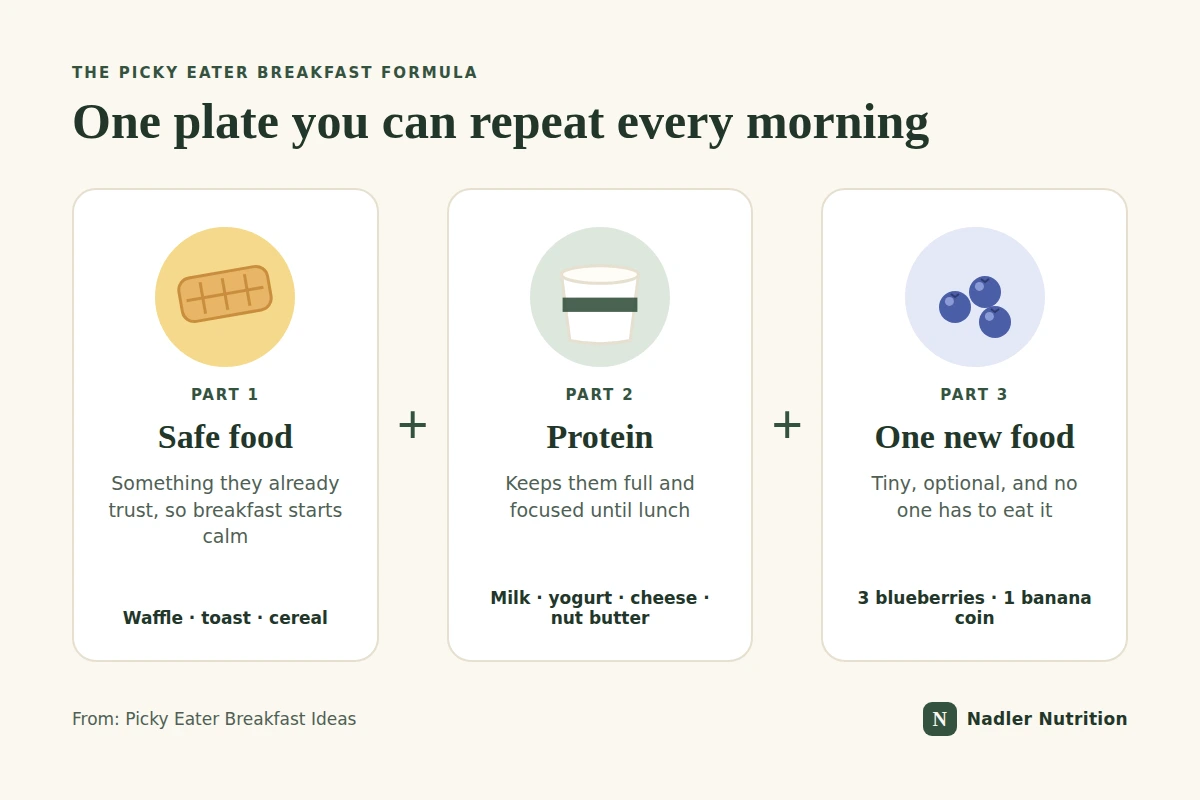
You do not need 30 breakfast recipes for picky eaters. You need one formula you can repeat, and then 30 ways to fill it in.
| Part of the plate | What it does | Examples |
|---|---|---|
| 1 safe food | Gives your child something they know they can eat, which lowers stress | Their usual waffle, toast, cereal, banana |
| 1 protein | Helps them stay full and focused until lunch | Milk, yogurt, eggs, nut or seed butter, cheese, cottage cheese |
| 1 exposure food (optional) | A small, no-pressure chance to see and smell something new | 3 blueberries, a strip of turkey bacon, a dab of cream cheese, a smoothie |
The exposure food is there to be seen, not necessarily eaten. Your child can ignore it, touch it or push it aside. Repeated, calm exposure is how kids learn to accept new foods, which is why the CDC’s tips for picky eaters and the American Academy of Pediatrics both suggest offering foods again and again without pressure.
How Much Protein Does My Child Need at Breakfast?
Short answer: less than most parents expect. A healthy breakfast for picky eaters does not need to be big, but it should have some protein. Children’s daily protein needs, from the Dietary Reference Intakes published by the National Academies, are:
| Age | Protein per day (RDA) | A realistic breakfast share |
|---|---|---|
| 1 to 3 years | 13 g | About 3 to 5 g |
| 4 to 8 years | 19 g | About 5 to 7 g |
| 9 to 13 years | 34 g | About 8 to 12 g |
The breakfast share is a practical rule of thumb (roughly a quarter to a third of the day), not an official target. Most kids who drink milk and eat a normal lunch and dinner reach their daily protein without any tracking. Breakfast protein matters most for picky eaters whose accepted foods lean heavily toward waffles, pancakes, cereal and bread.
Here is roughly how much protein common breakfast foods provide. Values are approximate and based on USDA FoodData Central, so check your labels.
| Food | Serving | Protein (about) |
|---|---|---|
| Milk (dairy) | 1 cup | 8 g |
| Plain Greek yogurt | 1 small container (5.3 oz) | 14 to 16 g |
| Cottage cheese | 1/2 cup | 12 g |
| Egg | 1 large | 6 g |
| Peanut butter or sunflower seed butter | 1 tablespoon | 3 to 4 g |
| String cheese | 1 stick or 1 oz | 6 to 7 g |
| Rolled oats (dry) | 1/2 cup | 5 g |
| Turkey sausage | 1 small patty | 5 to 7 g |
30 Picky Eater Breakfast Ideas, Sorted by the Problem They Solve
Pick the section that matches your mornings. Each of these breakfast foods for picky eaters keeps a familiar base, so your child sees something they recognize.
Familiar favorites, quietly upgraded
- Waffle sandwich: two toaster waffles with a thin layer of peanut or sunflower seed butter.
- Mini pancakes with a side of Greek yogurt for dipping.
- Cereal they already like, served with milk on the side instead of poured over it, for kids who don’t like mixing foods.
- Toast soldiers: buttered toast cut into strips, next to a few slices of cheese.
- French toast sticks made with an extra egg in the batter.
- Plain bagel half with butter or cream cheese, plus a glass of (chocolate) milk.
High protein breakfasts for picky eaters (no eggs required)
- Greek yogurt with a spoonful of their favorite cereal on top for crunch.
- Cottage cheese with some honey blended until smooth and spread on toast or used as a dip for fruit.
- Cheese quesadilla on a small tortilla, cut into triangles.
- Turkey sausage or chicken sausage coins next to their usual toast.
- Milk-based smoothie with banana, strawberry and nut or seed butter.
- Egg bites or mini frittata muffins, for kids who accept eggs in a firmer texture than scrambled.
Make-ahead breakfasts for busy school mornings
These easy breakfast ideas for picky eaters take 20 to 30 minutes on a weekend and save you every weekday.
- Overnight oats made with milk and mashed banana, served cold or warmed.
- Freezer pancakes or waffles you batch-cook on the weekend and toast on weekdays.
- Banana oat muffins baked in mini tins, frozen, and thawed in the microwave.
- Breakfast burritos with egg and cheese, wrapped in foil and frozen.
- Chia pudding made with milk, for kids who like smooth, cold textures.
- Hard-boiled eggs peeled on Sunday for a grab-and-go option.
Breakfasts for texture-sensitive kids and picky toddlers
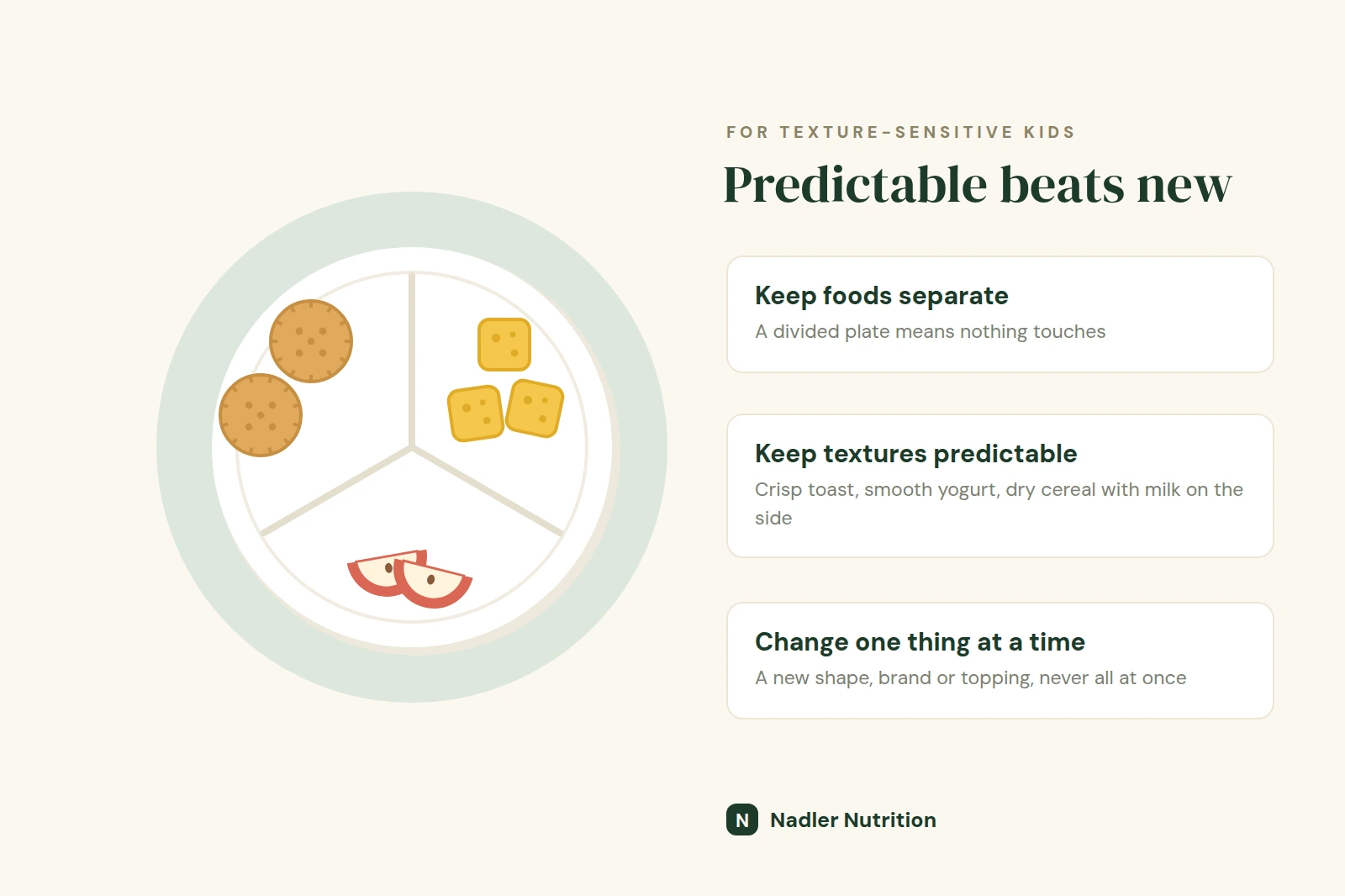
For kids with strong sensory preferences, predictability matters more than variety. Keep foods separate, keep textures consistent, and change one small thing at a time.
- A divided plate: crackers, cheese cubes and apple slices that do not touch.
- Smooth yogurt with toppings served on the side so your child controls how much they want to add.
- Crisp toast instead of soft bread, with butter spread thin and all the way to the edges.
- Oatmeal blended until smooth, for kids who refuse lumps.
Non-breakfast breakfasts
There is no rule that breakfast has to look like breakfast. If your child eats it at dinner, it can work in the morning.
- Leftover pasta with butter and parmesan.
- A plain cheese pizza slice, warmed.
- Rice with a little butter and a side of chicken.
- Leftover mac and cheese, warmed.
- Chicken nuggets and fruit.
Drinkable breakfasts for kids who are not hungry
- A small glass of milk with a banana to take in the car.
- A yogurt drink or smoothie, if your child likes them.
Breakfasts older kids can make themselves
Kids who help choose and make food are often more willing to eat it. These work well for children around 8 to 12 with a little supervision.
- Build-your-own yogurt parfait from three or four set-out toppings.
- Toaster waffle with nut or seed butter and sliced banana.
What If My Child Is Not Hungry in the Morning?
A child who is not hungry at 7 a.m. is not being difficult. Appetite in the morning is genuinely low for many kids, and forcing food can often backfire. A few changes help:
- Offer breakfast 30 to 60 minutes after waking, not the moment they get up.
- Look at the evening. A large snack close to bedtime often means a smaller appetite in the morning.
- Start with a drink. Milk or a smoothie is easier for many kids than solid food.
- Pack a portable second breakfast, such as a muffin and a cheese stick, for the car or a school snack.
- If your child takes ADHD medication that affects appetite, talk with their prescriber about timing, and plan a bigger breakfast before the dose if possible.
Skipping breakfast now and then is not a crisis. Research summarized by the AAP’s Breakfast for Learning page links regular breakfast with better attention and nutrition at school, so aim for something small most days rather than a perfect meal every day.
How to Get Your Picky Eater to Try a New Breakfast Food
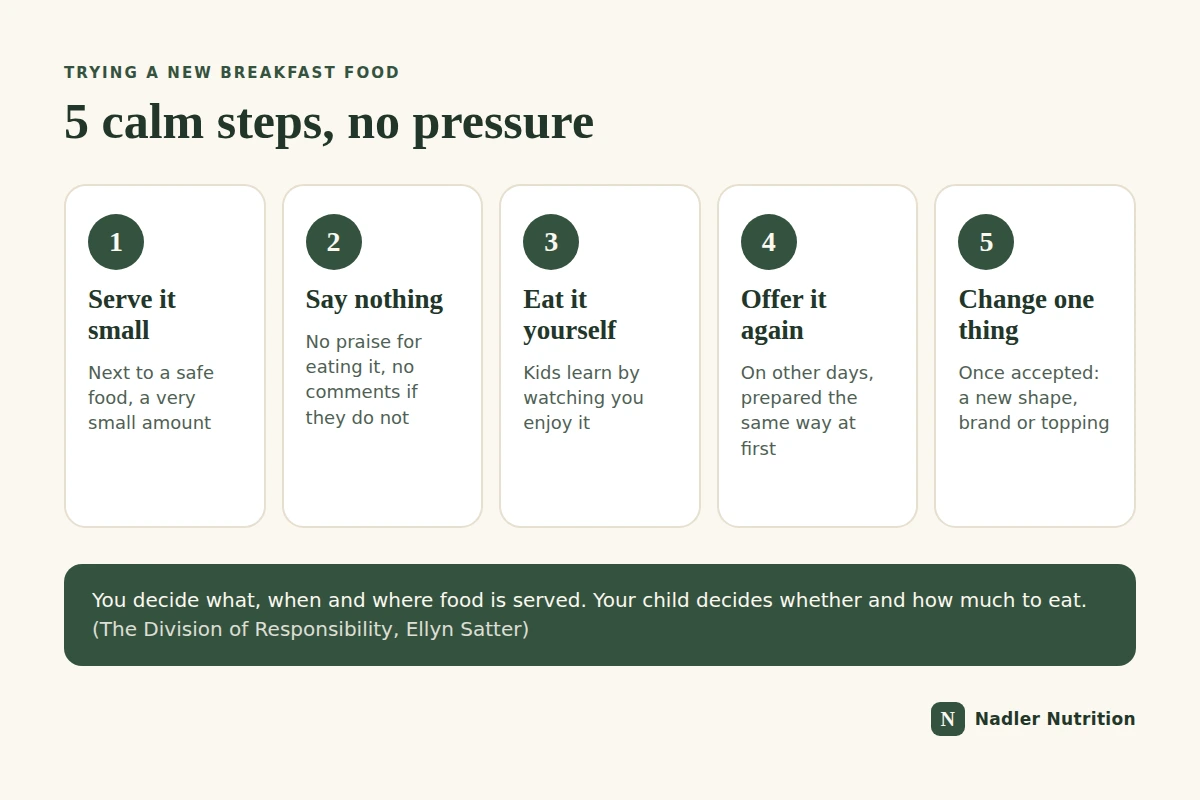
The approach that works best is the one that takes pressure off both of you. Many dietitians use the Division of Responsibility in feeding, developed by Ellyn Satter: you decide what, when and where food is served, and your child decides whether and how much to eat.
- Serve the new food next to a safe food, in a very small amount.
- Say nothing about it. No praise for eating it, no comments if they do not.
- Eat it yourself when you can, so your child sees it being enjoyed.
- Offer it again on other days, prepared the same way at first.
- Once it is accepted, change one small thing: a new shape, a new brand, or a new topping.
That last step is the idea behind food chaining, a method that moves kids from foods they love to similar new foods in small, predictable steps. For example, a child who eats one brand of toaster waffle might move to a homemade waffle, then a pancake, then a pancake with fruit baked in.
Allergy-Friendly Breakfast Swaps
Allergies and intolerances shrink an already short list. These swaps keep the formula intact.
| If your child avoids | Swap in | Protein tip |
|---|---|---|
| Eggs | Flax or chia egg in baking; cheese, yogurt or tofu scramble | Add Greek yogurt or cottage cheese on the side |
| Dairy | Soy milk or pea protein milk; dairy-free yogurt | Choose soy or pea milk, since many plant milks are low in protein |
| Peanuts and tree nuts | Sunflower seed butter or pumpkin seed butter | Seed butters give similar protein per spoonful |
| Gluten | Certified gluten-free oats, rice cakes, GF waffles or GF pancakes | Pair with eggs, yogurt or seed butter |
For more ideas, see our gluten-free, dairy-free breakfast ideas. If your child has a diagnosed food allergy, follow your allergist’s guidance on labels and cross-contact.
Common Breakfast Mistakes (and What to Do Instead)
- Hiding vegetables without telling your child. If they find it, trust drops. Serve foods openly and let them see what they are eating.
- Short-order cooking every morning. Offer choices within what you have planned, for example “waffle or toast,” rather than making anything on request.
- Letting them graze all morning. Grazing blunts hunger for real meals. Set a breakfast time and a snack time.
- Relying on juice. Juice fills small stomachs with a lot of sugar and without any protein. Milk or water with food works better.
- Using dessert as a reward for eating breakfast. It teaches that breakfast food is the price you pay for the good stuff.
Breakfast Ideas for Kids With ADHD
Parents often ask what kids with ADHD should eat for breakfast. The same formula applies, with a little extra attention to protein and to timing around medication. A breakfast with protein and some fiber tends to give steadier energy than a sugary cereal alone. Our ADHD nutrition support page and our guide to the best ADHD diet for kids go further on this.
When Picky Eating Is More Than a Phase
Most picky eating improves with time and calm, repeated exposure. Talk with your pediatrician, and consider working with a pediatric dietitian, if your child:
- Eats a very short list of foods that keeps getting shorter
- Gags, vomits or becomes very upset around new foods
- Has lost weight or dropped off their growth curve
- Refuses entire food groups, such as all fruits or all proteins
These can be signs of problem feeding or ARFID. Our article on picky eating vs ARFID in kids explains the difference, and our picky eating support page shows how virtual one-on-one help works.
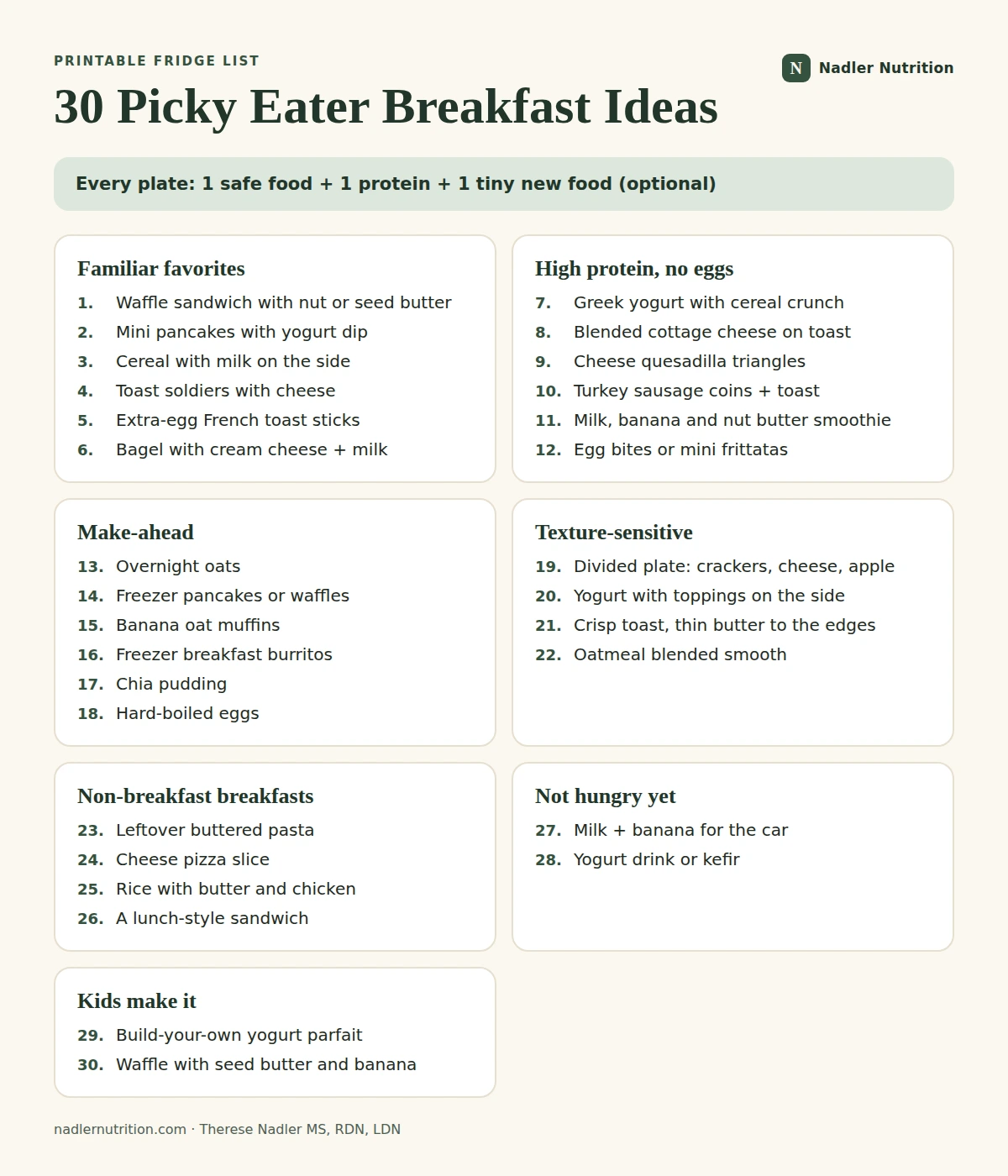
Printable: 30 Picky Eater Breakfast Ideas
Save or print this list and keep it on the fridge for busy mornings.
The Bottom Line
The best picky eater breakfast ideas are not super involved recipes, and a good breakfast for picky eaters rarely looks like a magazine photo. They are familiar foods, a bit of protein and a calm, predictable routine. Pick two or three ideas from this list, keep one safe food on the plate every morning, and offer new foods without pressure. Small, boring consistency is what widens a child’s plate over time.
If breakfast is only one part of a bigger struggle, you do not have to work it out alone. Book a free consultation to talk through what is happening at your table. For the rest of the day, try our school lunch ideas, healthy snack swaps and picky eater dinner ideas.
Picky Eater Breakfast FAQs
What can I give my picky eater for breakfast?
Start with a food your child already eats, add a simple protein such as milk, yogurt, cheese or nut butter, and optionally place a small new food on the side. Waffle sandwiches, cheese quesadillas, yogurt with cereal on top and banana oat muffins are easy places to start.
What should I give a child who does not like breakfast?
Offer something small and familiar 30 to 60 minutes after waking, or start with a drink such as milk or a smoothie. Non-breakfast foods like leftover pasta or a sandwich are fine too. A portable snack for later in the morning can help fill the gap.
How much protein does my child need at breakfast?
Daily protein needs are about 13 g for ages 1 to 3, 19 g for ages 4 to 8 and 34 g for ages 9 to 13. A breakfast with roughly a quarter to a third of that, such as a cup of milk and a slice of cheese, is plenty for most kids.
What are high protein breakfast ideas for picky eaters who do not eat eggs?
Try Greek yogurt with cereal on top, blended cottage cheese with a little honey on toast, a cheese quesadilla, turkey sausage with toast, or a milk and banana smoothie with seed butter. Each provides protein without eggs.
Is it OK to serve lunch or dinner foods for breakfast?
Yes. Leftover pasta, rice, pizza or a sandwich can be a perfectly good breakfast. What matters is that your child eats something with some protein, not whether it looks like a typical breakfast.
Should I hide vegetables in my child’s breakfast?
It is better not to. If a child discovers hidden food, it can reduce their trust at meals. Serve fruits and vegetables openly in small amounts alongside safe foods so your child can get used to them.
What if my child only eats cereal or waffles for breakfast?
Keep serving the cereal or waffle, and build around it. Add a protein such as milk, yogurt or nut butter, and place a tiny portion of a new food on the side. Over time, small changes like a new topping or brand can widen the list.
What are good breakfast ideas for picky toddlers?
Soft, easy-to-hold foods work well: mini pancakes, toast strips, banana, yogurt, scrambled eggs if accepted, and small cheese cubes. Keep portions small and offer the same foods often, since toddlers usually need many exposures before accepting something new.
Is skipping breakfast bad for kids?
An occasional skipped breakfast is not harmful. Regular breakfast is linked with better attention and nutrition at school, so aim for something small most days, even if it is just milk and a piece of fruit.
Explore related articles on the website:
- Food Chaining for Picky Eaters: Step-by-Step Ladder
- 40 Picky Eater Dinner Ideas Kids Will Actually Eat
- Picky Eating Causes and the Top 10 Fixes for Kids
Written by Therese Nadler MS, RDN, LDN, Functional & Integrative Registered Dietitian Nutritionist (RDN)
This article is for educational purposes only and is not medical advice or a substitute for individualized care. Every child is different; for concerns about your child’s growth, nutrition, or eating, consult your pediatrician or a registered dietitian.
References:
- Centers for Disease Control and Prevention. Tips to Help Your Picky Eater. Link
- American Academy of Pediatrics, HealthyChildren.org. 10 Tips for Parents of Picky Eaters. Link
- Institute of Medicine. (2003). Dietary Reference Intakes: Reference Tables. National Academies Press. Link
- U.S. Department of Agriculture, Agricultural Research Service. FoodData Central. Link
- American Academy of Pediatrics, HealthyChildren.org. Breakfast for Learning: Why the Morning Meal Matters. Link
- Ellyn Satter Institute. The Division of Responsibility in Feeding. Link